 |  |  |  |  |  |  |

|

|

|

|

|

|
|
BY REGINA MADDEN |

"The children get so much fun out of the Frog Pond, don't they?" There was something very cool and restful about her voice. "She's fond of children," I thought. "That's the first qualification for her recent appointment to the Advisory Committee to the Youth Service Board." |
"The children get so much fun out of the Frog Pond, don't they?" There was something very cool and restful about her voice. "She's fond of children," I thought. "That's the first qualification for her recent appointment to the Advisory Committee to the Youth Service Board." I was frankly curious about this tall, slim, lissom lady, who could crowd several appointments into a sultry mid-Summer day and still at the end of the afternoon create around her an atmosphere of leisurely tranquility. I was curious not only concerning her qualifications for membership on this important committee, which has been handed the momentous juvenile delinquency problem to solve, but also concerning her ability to render so much |
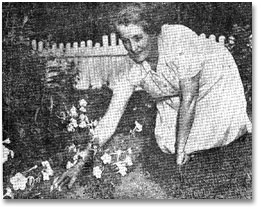
ON THE FARM IT'S POTATOES — Mrs. Driscoll weeds the petunia bed in her home garden. |
| valuable public
service while doing a first-class job of bringing up a family; for Mrs.
Driscoll is before all other things a mother – a mother of seven children.
It did not take long to discover that it is out of her motherhood that have developed her interest in public affairs and her sense of responsibility toward the community in which she lives. "A mother," she said in the course of our conversations, "owes it to her children to do her part in improving conditions in the community in which they live." It was after the birth of her last child that, having decided she wanted to know more about child psychology and the proper methods of educating children, she enrolled in Boston University to work for the degree of Master of Education. Two years prior to her marriage she had received a bachelor's degree from Simmons College. Her special interest was in the methods of education of the child of pre-school age, which she believes to be the most determinant period of the child's life. At this time she became a director of the Stern Nursery School. First Woman on Milk Board Interest in child welfare legislation led Mrs. Driscoll to membership in the League of Women Voters and eventually to presidency of the League of Women Voters and eventually to presidency of the Boston League. She felt that such and organization offered the opportunity to get unbiased information on current issues and to lend support to efforts to obtain wise legislation. It was during her term as president, when the League was concerned with the controversial problems of milk economics that she was appointed by then Gov. Saltonstall to a six-year term on the Milk Control Board, the first woman to serve on that board. Behind all the energy she invested in this assignment was her interest in seeing to it that no economic entanglement blocked the channels that supplied the children of the state with proper nourishment. The war brought personal problems and cares to Mrs. Driscoll as it did to most mothers. Yet she accepted the chairmanship of the Committee on day Care of Children of working Mothers and all the work and responsibility entailed by the position and held it for three years. If the pressing demands for war labor were taking mothers out of their homes, provision must be made for the care of their children while they were at work. She deplores the fact that the public nurseries in Boston were closed after the war. This is a subject on which she feels strongly. "It is not," she said, "that we want to encourage mothers to leave their children and go out to work to earn money for luxuries, but we want to give an opportunity to work to those mothers who are reluctant to accept charity but have no income. I am sure that if the people of Boston as a whole knew of some of the sad cases of hardship that resulted from the closing of the nurseries, they would make immediate provision for their re-opening. She Hoes Potatoes In addition to filling her new position on the Advisory Committee to the Youth Service Board, Mrs. Driscoll at present is serving as vice president of the Massachusetts League of Women Voters and as vice president and member of the Greater Boston Community Council, and organization for cooperative planning and action in the field of health and welfare services. "But where did you find the leisure to develop that beautiful coat of tan?" She looked down at her slim hands and laughed, "I got that hoeing potatoes up on our farm in Deering." |
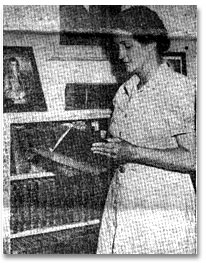 ITS IRISH LITERATURE NOW — Mrs. Driscoll's son Phil is concentrating on that subject |
She enjoys a Summer sojourn
on the farm. There is something about farm life that gives a sense of
the futility of rushing around, that gives a feeling of tranquility, she
believes. And that is the feeling that Mrs. Driscoll herself givers to
others. As one of her friends remarked, "She is so serene that she makes
others feel the same." One might well wonder how much leisure she has at the farm; for she does not take a maid along, and it is the usual thing for her to have 15 or 16 up there for the week-end. The children feel free to invite their friends for dinner or for a week-end whenever they want to. She rejects the suggestion that such entertaining means a great deal of extra work with the assurance that everyone helps. That is the way the Driscoll children have been brought up. Each one has always had his special tasks and responsibilities in the home. |
| Mrs. Driscoll's skill in cooking has made dinner at her home an occasion for the most fastidious gourmet to remember. Mention of a dinner invitation from her invariably brings for the question, "Have you ever had any of her Oysters Rockefeller?" the speaker's mouth watering in the recollection of that gustatory experience. In among her other activities last year she managed to tuck the Cordon Bleu course in cooking. She finds time, too, to keep up with the interests and enthusiasms of her husband and children. Here knowledge of the housing situation seems amazing until one remembers that Mr. Driscoll is Regional House Expediter. The children's interests are quite varied. John, the oldest, has since graduating from Harvard been in business with the National Appraisers' Association. When Edgar Jr. got through Harvard, he decided on a newspaper career and is now on the Boston Globe staff, writing frequently on art exhibits. Phil, who teaches at Notre Dame University, is working for his Ph. D. at Harvard, concentrating in the field of contemporary Irish literature. His mother usually has a recent Irish novel on her bedside table, Bill, a graduate of the Cambridge School, is training with the Woolworth Company in the Manchester, N.H., store. One of the boys, 12-year-old Robin, is still in school, a student in the River School. Sheila Driscoll is now Mrs. Ingersoll Cunningham, while Kay, sharing her mother's interest in pre-school-age children, is teaching in a nursery school in Lincoln. This past week Ed flew to Europe for his vacation and what an exciting time his mother had, helping him plan his itinerary. When Mrs. Driscoll talks of her children, her eyes are filled with little laughing lights. She finds being a mother a great deal of fun. But there was no hesitation in her manner when she was asked what she thought of mothers' taking an active part in public affairs. "I believe," she answered, that every mother's first responsibility is her family, but there comes a time when her children outgrow the need of her constant attention. Then it is time for her to accept her proper share of responsibility for the community she lives in. But that doesn't mean that women with small children are exempt from all such responsibility. Women don't need to stir out of their homes to exert and influence. They can always keep informed on the issues of the day and write to their representatives to express their convictions on the issues." |
 |
|  |
|  |
| 
|